From the early years of the stone age to the modern day, nalbinding plays a central role in the development of textiles.
We’ll never know where nalbinding was first invented, or who developed it. Given the wide distribution of archaeological examples, it’s most likely that it was independently developed all over the world. This mirrors weaving, braiding, and cord-making in general; every inhabited continent has evidence of the basic textile crafts with local variations.
Theories on how nalbinding developed
From sewing
Before humans wore clothing made from fabric, we used animal furs and hides. Basic flint blades allowed early humans to cut the hides to shape and punch holes in them. Leather cord, sinew, or plant fibers were then threaded through the holes to attach pieces of hide together.
While cords can be threaded through holes without a needle, the oldest known needle with an eye dates back roughly 30,000 years. As sewing techniques became more complex, early humans likely added decorative stitching to their leather clothing. This may have developed into what we now call nalbinding.
From weaving
Weaving entered the archaeological record as early as 27,000 years ago, during the Paleolithic era. Early weavers likely used plant fibers, reeds, and other readily-available cord-like materials. As humans discovered how to spin fibers together into cord and yarn to strengthen them, weaving and textiles in general became more complex as a result.
Once a piece of weaving is finished, there’s some waste from the warp (the first set of fibers through which other fibers are woven). With all the effort and time that goes into making cord or yarn of any variety, it seems unlikely that weavers would have simply discarded this waste. Efforts to repurpose it could have developed into nalbinding.

This timeline is still under construction. Please check back regularly for more entries.
Neolithic Era
Oldest known sample
approx. 8000 BCE
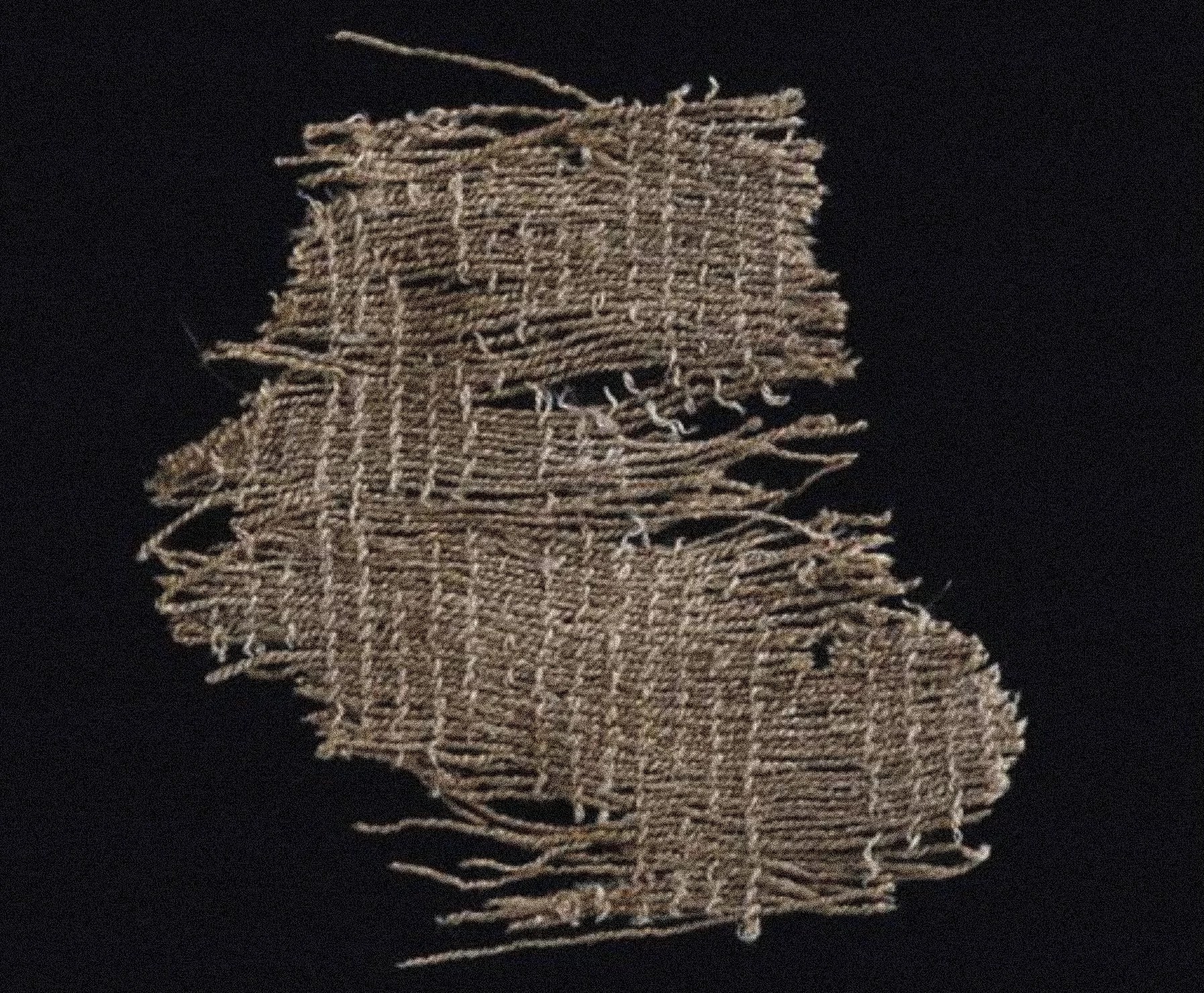
The oldest known piece of nalbinding in the archaeological record was made. The sample is various small fragments made from mostly plant fibers. One fragment may have been made from human hair.
Discovered in: Nahal Hemar, Israel
Image courtesy of antiquities.org.il

Sources
Bar-Yosef, Ofer. “A Cave in the Desert, Nahal Hemar: 9000-Year-Old-Finds.” 1985, pp.9-10.
Schick, Tamar. “Nahal Hemar Cave – Cordage, Basketry and Fabrics.” ‘Atiquot / 18, 1988, pp.34-35. Table XVI.
Oldest known European sample
approx. 7750 – 6850 BCE
The oldest known piece of nalbinding from Europe was made. The fragments, likely from a fishing net, were constructed with simple and twisted linking and looping. The yarn is S-spun and Z-plied and made from plant fibers, possibly willow bast.
Discovered in: Friesack, Germany
Image courtesy of Stanford University Library

Sources
Bonsall, John. “The Mesolithic in Europe: Papers presented at the Third International Symposium, Edinburgh 1985.” 1989, pp. 323, Fig. 7.
Kernchen, Ilona and Gramsch, Bernhard. “Mesolithische Ntez- und Seilreste von Friesack, Bezirk Potsdam, und ihre Konservierung.” Veröffentlichungen des Muesums für Ur- und Frühgeschichte Potsdam, Bd. 23, 1989, pp.23-27, Fig. 1 and Tables 6-9.
Tybrind Vig net fragments
approx. 4200 BCE
This sample consists of roughly a dozen fragments, made with different stitch types from Z-spun vegetable fibers. The fragments were probably pieces of fishing nets.
Discovered in: Tybrind Vig, Denmark
Image courtesy of abc.se

Sources
Andersen, Søren H. “Tybrind Vig, A Preliminary Report on a Submerged Ertebølle Settlement in tge West Coast of Fyn.” Journal of Danish Archaeology, vol. 4, 1985, pp. 52-69.
Bender Jørgensen, Lise. “Stone-Age Textiles in Northern Europe.” Textiles in Northern Archaeology, Textile Symposium in York, North European Symposium for Archaeological Textiles Monograph 3, NESEAT III, London 1990.